
 Cart : 0
 Account
A research group from the Republic of Korea developed poly(ethylene glycol)-conjugated hyaluronic acid nanoparticles (PEG-HANPs)…

PEGylated Nanoparticle Technologies: Mechanisms and Therapeutic Applications – Liposome, Lipid Nanoparticle, Polymeric Micelles
Polyethylene glycol (PEG) surface modification, or PEGylation, constitutes a foundational strategy in nanomedicine for enhancing the pharmacokinetic and pharmacodynamic profiles of nanoparticle-based drug delivery systems. By imparting steric stabilization and hydrophilicity, PEGylation mitigates opsonization, prolongs systemic circulation, and facilitates passive accumulation at disease sites through the enhanced permeability and retention (EPR) effect.
1. PEGylated Liposomes
PEGylated liposomes represent the most clinically mature class of PEGylated nanoparticles. These vesicular structures consist of phospholipid bilayers enclosing an aqueous core, with PEG chains (typically 2 kDa) covalently conjugated to lipid anchors such as distearoylphosphatidylethanolamine (DSPE-PEG). The PEG corona forms a hydrated brush layer that sterically repels plasma proteins and phagocytic cells of the mononuclear phagocyte system (MPS).
Key Examples and Uses:
- Doxil® (pegylated liposomal doxorubicin): The first FDA-approved PEGylated nanomedicine (1995), it encapsulates doxorubicin within a PEGylated liposomal carrier, achieving a circulation half-life of approximately 36–72 hours and reducing cardiotoxicity by nearly 50% compared with free drug. Primary indications include ovarian cancer, multiple myeloma, and Kaposi’s sarcoma.
- Onivyde® (pegylated liposomal irinotecan): Approved in 2015 for metastatic pancreatic adenocarcinoma post-gemcitabine therapy; PEGylation enhances tumor accumulation and minimizes off-target toxicity.
These systems excel in the intravenous delivery of both hydrophilic and hydrophobic payloads, with applications extending to combination therapies and imaging agents. Recent investigations explore ligand-functionalized PEG termini for active targeting of overexpressed receptors (e.g., HER2 or EGFR) in solid tumors.
2. PEGylated Lipid Nanoparticles (LNPs)
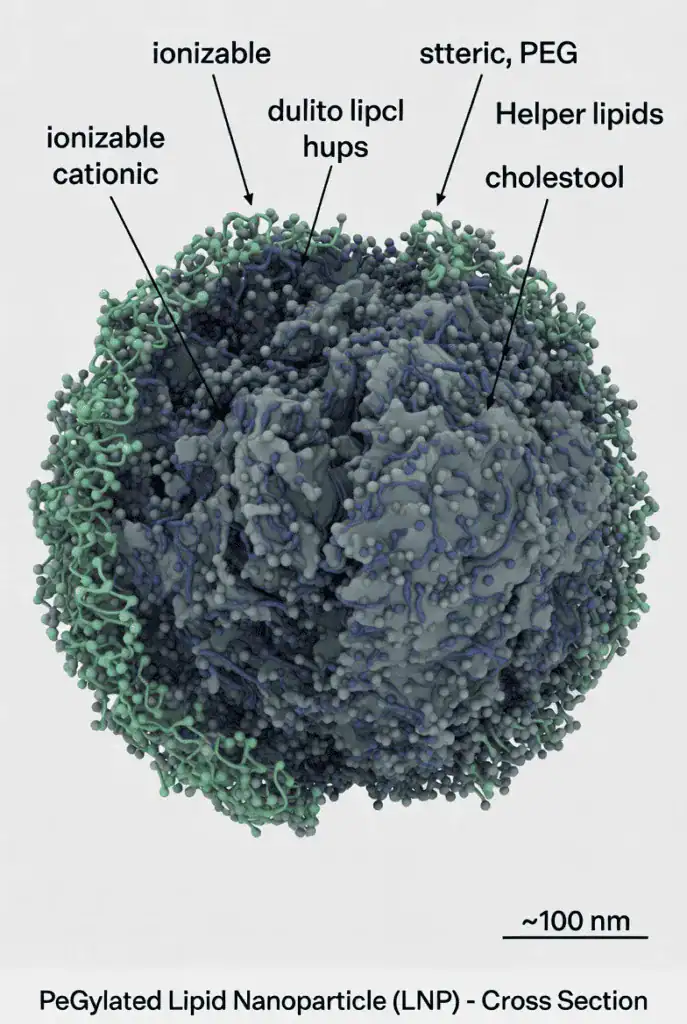
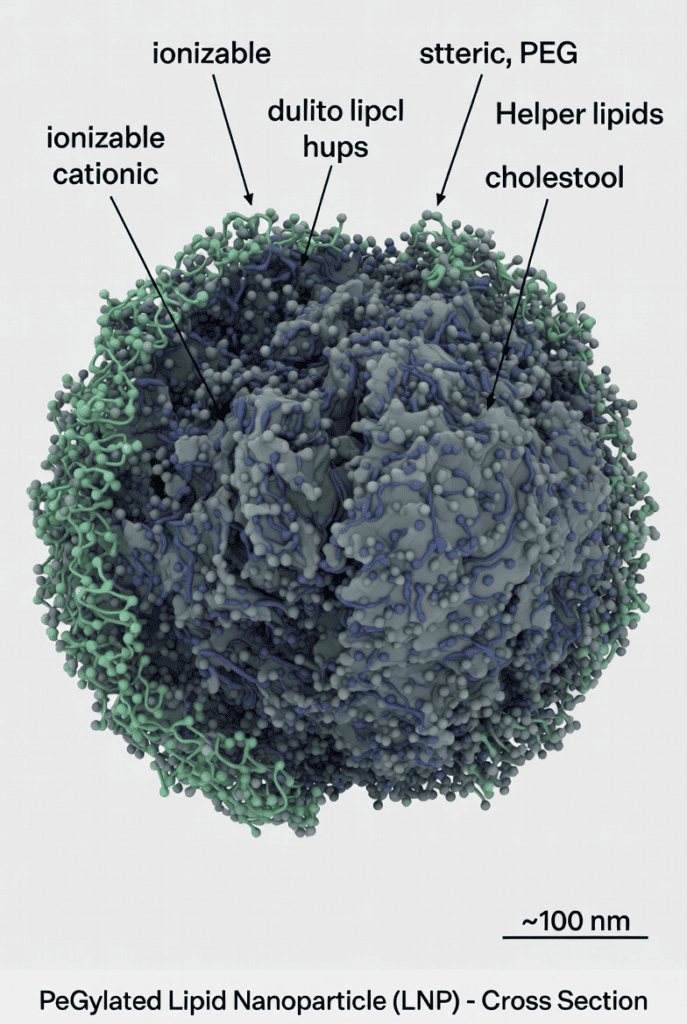
Distinct from traditional liposomes, LNPs comprise ionizable cationic lipids, helper lipids, cholesterol, and PEG-lipids (typically 1–2 mol% of 2 kDa PEG). This composition enables electrostatic complexation with nucleic acids while maintaining near-neutral surface charge at physiological pH, thereby minimizing systemic toxicity. PEGylation ensures colloidal stability during storage and circulation, preventing aggregation and premature clearance.
Key Examples and Uses:
- Comirnaty™ and Spikevax®: mRNA-based COVID-19 vaccines (BioNTech/Pfizer and Moderna, respectively), where PEG-lipid components confer extended circulation and efficient endosomal escape for antigen expression.
- Onpattro® (patisiran): The first FDA-approved siRNA therapeutic (2018), utilizing PEGylated LNPs for the treatment of hereditary transthyretin-mediated amyloidosis; systemic delivery targets hepatocytes with high specificity.
LNPs are particularly suited for RNA therapeutics, gene editing (e.g., CRISPR-Cas9 delivery), and vaccine platforms. Ongoing trials evaluate their utility in cancer immunotherapy and protein replacement therapies.
3. PEGylated Polymeric Nanoparticles
These nanoparticles typically employ biodegradable polyesters such as poly(lactic-co-glycolic acid) (PLGA) or poly(lactic acid) (PLA) as the core, with PEG forming a diblock copolymer shell (e.g., PLGA-PEG or PLA-PEG). Fabrication occurs via nanoprecipitation, emulsion solvent evaporation, or nano-emulsion templating, yielding particles 50–200 nm in diameter. PEGylation (commonly 5 kDa chains at high density) confers stealth properties while enabling controlled drug release through polymer degradation.
Key Examples and Uses:
- PEG-PLGA nanoparticles: Extensively investigated for hydrophobic chemotherapeutics (e.g., paclitaxel, doxorubicin) in breast, prostate, pancreatic, and lung cancers. Ligand conjugation (e.g., LHRH or glucose) to PEG termini facilitates receptor-mediated endocytosis.
- Hybrid lipid-polymer nanoparticles (LPHNPs): Combine a polymeric core with a lipid-PEG shell, enhancing encapsulation efficiency and mucus penetration for oral or mucosal delivery.
Applications include sustained-release formulations, combination therapy (e.g., chemotherapeutic plus epigenetic modulators), and blood–brain barrier crossing when optimized for dense PEG coatings. Clinical translation remains active in oncology pipelines.
4. PEGylated Polymeric Micelles
Micelles self-assemble from amphiphilic block copolymers (e.g., PEG–poly(ε-caprolactone), PEG–DSPE, or PEG–cholesterol), forming a hydrophobic core for drug solubilization and a PEG corona for stabilization. Particle sizes typically range from 10–100 nm, ideal for exploiting the EPR effect.
Key Uses:
- Delivery of poorly water-soluble anticancer agents (e.g., paclitaxel or doxorubicin) with prolonged circulation (half-lives up to 17 hours at optimal PEG molecular weights). Intratumoral or intravenous administration has demonstrated tumor regression in preclinical models, with reduced systemic toxicity.
- Emerging applications in photodynamic therapy and theranostics when co-loaded with imaging agents.
Micelles offer high drug-loading capacity and rapid cellular internalization once extravasated into tumor tissue.
5. PEGylated Dendrimers and Other Specialized Platforms
Dendrimers are monodisperse, hyperbranched macromolecules (e.g., poly(amidoamine) or polyester-based) with numerous surface groups that can be partially PEGylated to balance solubility, circulation time, and drug conjugation capacity.
Uses:
- High-capacity carriers for small-molecule drugs, nucleic acids, or imaging probes in cancer and neurodegenerative disorders. PEGylation mitigates cytotoxicity while enhancing blood–brain barrier penetration when combined with targeting ligands.
Additional platforms include PEGylated inorganic nanoparticles (e.g., gold nanoparticles for photothermal therapy or mesoporous silica for controlled release) and chitosan-PEG hybrids for mucosal or gene delivery. These systems leverage PEG for biocompatibility while exploiting the unique optical or magnetic properties of the core material.
Considerations for Clinical Translation and Future Directions
While PEGylation has enabled multiple FDA-approved products and numerous candidates in late-stage trials, challenges such as the “PEG dilemma” (impaired cellular uptake) and anti-PEG antibody formation (affecting 20–25% of individuals) necessitate careful design optimization. Strategies include stimuli-responsive “sheddable” PEG coatings, alternative stealth polymers (e.g., poly(2-oxazolines) or zwitterionic materials), and personalized immunogenicity screening.
In summary, PEGylated nanoparticle technologies span a diverse spectrum—from established liposomal systems to advanced polymeric and lipid platforms—each tailored to specific therapeutic payloads and administration routes. Their continued refinement promises sustained improvements in precision drug delivery across oncology, genetic medicine, and beyond, underscoring their central role in contemporary pharmaceutical development.