 Cart : 0
 Account
A new ingredient is sweeping the anti-aging beauty scene and completely revolutionizing it. Where injections…

How to measure molecular weights of hyaluronic acid? The three methods we use: SEC-MALS, conventional SEC and Intrinsic Viscosity methods
The molecular weight (MW) of hyaluronic acid (HA) is most accurately determined using size-exclusion chromatography coupled with multi-angle light scattering (SEC-MALS), which provides absolute weight-average MW values independent of calibration standards. For routine or resource-limited applications, conventional SEC calibrated with HA-specific standards offers a reliable relative MW estimate, while intrinsic viscosity (IV) measurements, interpreted via the Mark-Houwink equation with appropriate K and a constants (typically a ≈ 0.77–0.80 in 0.1–0.2 M NaCl), provide a rapid, low-cost alternative yielding viscosity-average MW. Each method requires careful control of solvent conditions to minimize polyelectrolyte effects and ensure reproducibility.
SEC-MALS
Size-exclusion chromatography coupled with multi-angle light scattering (SEC-MALS) provides an absolute method for determining the molecular weight of hyaluronic acid (HA, typically as sodium hyaluronate) without reliance on calibration standards or empirical relationships such as the Mark-Houwink equation required for intrinsic viscosity methods.
Principle of SEC-MALS
SEC separates HA molecules primarily according to hydrodynamic volume, with larger molecules eluting earlier. MALS measures the intensity of scattered light at multiple angles as the eluate passes through a flow cell. For macromolecules in dilute solution, the Rayleigh-Debye approximation relates scattered light intensity to molecular properties:

where:
- Rθ is the excess Rayleigh ratio (scattered intensity corrected for solvent and background),
- K is an optical constant incorporating wavelength, refractive index increment (dn/dc), and incident light intensity,
- c is concentration (determined simultaneously by a differential refractive index (dRI) detector),
- M is the weight-average molecular weight (Mw) at each elution slice,
- P(θ) is the form factor describing angular dependence (yielding the z-average radius of gyration Rg for larger molecules),
- A2 is the second virial coefficient (often negligible at low concentrations).
In practice, extrapolation of Kc/Rθ to zero angle and zero concentration (Zimm plot principle, applied slice-by-slice) yields absolute Mw directly. The dRI detector provides c via:
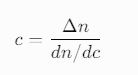
where Δn is the refractive index difference.
A UV detector may be included for additional concentration verification or compositional analysis in conjugates.
Application to Hyaluronic Acid
HA, a high-molecular-weight glycosaminoglycan, is typically analyzed under the following conditions to minimize polyelectrolyte effects and aggregation:
- Solvent: 0.1–0.2 M NaCl (or phosphate-buffered saline) at neutral pH.
- Columns: Aqueous-compatible SEC columns (e.g., TSKgel PWxl or Superose series) suitable for 10 kDa to several MDa range.
- Temperature: Usually 25–40 °C.
- Flow rate: 0.5–1.0 mL/min.
- Sample concentration: 0.1–2 mg/mL (dilute to avoid non-ideal effects).
- Key input parameter: Accurate dn/dc for sodium hyaluronate (commonly 0.153–0.165 mL/g in 0.1–0.2 M NaCl; literature values around 0.153 mL/g are frequently used; precise measurement by dRI at the same wavelength and solvent is recommended for highest accuracy).
SEC-MALS yields:
- Absolute weight-average molecular weight (Mw) across the distribution.
- Polydispersity index (Mw/Mn), where number-average Mn is derived from integration.
Conventional size-exclusion chromatography (SEC)
Conventional size-exclusion chromatography (SEC), also referred to as gel permeation chromatography (GPC) or high-performance size-exclusion chromatography (HPSEC), determines the molecular weight (MW) of hyaluronic acid (HA, typically sodium hyaluronate) by separating molecules based on hydrodynamic volume and comparing their elution behavior to a calibration curve constructed from standards of known MW. Unlike SEC-MALS, which provides absolute MW values, conventional SEC yields relative (apparent) MW values dependent on the calibration standards and conditions.
Principle
In SEC, larger molecules elute earlier due to limited access to the porous stationary phase, while smaller molecules penetrate pores more deeply and elute later. A detector (typically refractive index (RI) or UV at ~206–210 nm for HA) records the elution profile. The retention time (or elution volume) of a sample is correlated to MW via a calibration curve plotting log(MW) versus retention time (or elution volume) for standards.
For HA, the relationship is approximately linear over the separation range of the columns, though the extended coil conformation of HA can lead to deviations if standards differ in structure.
Step-by-Step Procedure for Conventional SEC of HA
- Instrument and Column Selection:
- Use aqueous-compatible SEC columns (e.g., TSKgel PW series, Shodex OHpak SB, or Superose) designed for high-MW polysaccharides (separation range typically 10 kDa to >10 MDa).
- Mobile phase: 0.1–0.2 M NaNO₃, NaCl, or phosphate-buffered saline (neutral pH) to screen polyelectrolyte effects and prevent aggregation or ion exclusion.
- Calibration:
- Prepare a calibration curve using standards with known MW.
- Preferred: Narrow or defined HA standards (e.g., commercially available sodium hyaluronate standards from 10 kDa to several MDa, characterized by SEC-MALS). These provide the most accurate results because they match HA’s chemistry, conformation, and hydrodynamic behavior.
- Common alternatives (less accurate): Pullulan, polyethylene oxide (PEO), or dextran standards.
- Pullulan or PEO calibration often overestimates HA MW by 2–10 fold due to differences in chain stiffness and excluded volume (HA is more extended than pullulan in aqueous salt solutions).
- Inject a series of standards, plot log(MW) versus retention time (peak maximum), and fit a linear or polynomial regression. Software typically performs this automatically.
- Sample Preparation and Analysis:
- Dissolve HA at low concentration (0.1–1 mg/mL; higher concentrations cause underestimation due to viscosity effects or non-ideal behavior).
- Filter through 0.22–0.45 μm membrane to remove aggregates.
- Inject sample (typically 20–100 μL) at controlled flow rate (0.5–1.0 mL/min) and temperature (25–40 °C).
- Record chromatogram and determine peak retention time or distribution.
- MW Calculation:
- Use the calibration equation to convert retention times to MW.
- Report weight-average MW (Mw), number-average MW (Mn), polydispersity (Mw/Mn), and peak MW (Mp) by integrating the chromatogram.
- For polydisperse HA, calculate averages across the distribution:
- Mw = Σ (h_i · M_i) / Σ h_i
- Mn = Σ h_i / Σ (h_i / M_i) (where h_i is detector response at slice i).
Intrinsic viscosity to measure MW of HA
The determination of the molecular weight (MW) of hyaluronic acid (HA) using intrinsic viscosity relies on the well-established relationship provided by the Mark-Houwink equation (also known as the Mark-Houwink-Sakurada equation):
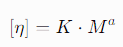
or, in logarithmic form for practical calculation:

Here, [η] is the intrinsic viscosity (typically in units of dL/g or mL/g), M is the viscosity-average molecular weight (Mv), and K and a are empirical constants specific to the polymer, solvent, temperature, and ionic strength conditions. For hyaluronic acid (usually as sodium hyaluronate), the exponent a is typically in the range of 0.7–0.8 under physiologically relevant conditions (e.g., aqueous NaCl solutions at moderate ionic strength), reflecting a semi-flexible coil conformation in good solvents.
Step 1: Experimental Determination of Intrinsic Viscosity [η]
Intrinsic viscosity is the limiting value of the reduced viscosity as polymer concentration approaches zero, where intermolecular interactions become negligible.
Common procedure for HA:
- Prepare a series of dilute HA solutions (typically 0.01–0.1 g/dL or lower) in an appropriate solvent, such as 0.1–0.2 M NaCl aqueous solution at 25°C. The salt suppresses polyelectrolyte effects and yields reproducible values.
- Measure the flow times of the solvent (t0) and each solution (t) using a capillary viscometer (e.g., Ubbelohde or Ostwald type) under precise temperature control.
- Calculate:
- Relative viscosity: ηr=t/t0 (assuming negligible density difference at low concentrations)
- Specific viscosity: ηsp=ηr−1
- Reduced viscosity: ηred=ηsp/c (where c c c is concentration in g/dL)
- Inherent viscosity: ηinh=ln(ηr)/c
- Plot reduced viscosity (ηred \eta_{red} ηred) and inherent viscosity (ηinh) versus concentration.
- Extrapolate both lines to zero concentration (Huggins and Kraemer plots, respectively). The common intercept is the intrinsic viscosity [η].
For high-MW HA, automated or microfluidic viscometers may be advantageous due to the high viscosities even at low concentrations.
Step 2: Application of the Mark-Houwink Equation
Once [η] is obtained, solve for M:
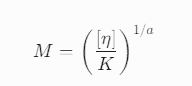
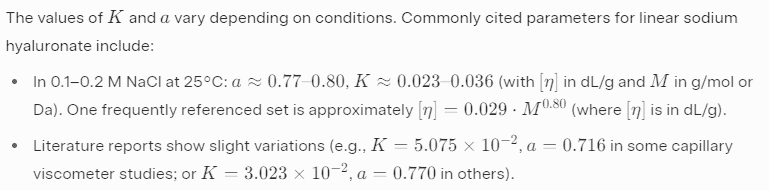
Due to these variations, it is strongly recommended to:
- Use parameters validated for your exact solvent, temperature, and HA form (e.g., sodium salt).
- Calibrate against known MW standards (e.g., via SEC-MALS) if high precision is required.
Advantages Over Intrinsic Viscosity or Conventional SEC
- SEC_MALS: Absolute determination—no standards or Mark-Houwink parameters required (unlike viscometry or conventional SEC with column calibration, which can introduce errors for HA due to its extended coil and variable conformation). Provides full molecular weight distribution and polydispersity. Detects aggregates, degradation products, or conformational changes. Suitable for linear, cross-linked, or conjugated HA (e.g., in drug delivery systems).
- Conventional SEC: a practical, relative method for HA characterization but is prone to systematic errors unless calibrated with HA standards.
- Intrinsic viscosity: The method yields the viscosity-average molecular weight (Mv), which lies between the number-average (Mn) and weight-average (Mw) values. HA is a polyelectrolyte; insufficient salt screening can lead to chain expansion and overestimated [η]. The relationship holds best for linear HA; crosslinking or degradation may alter the conformation and thus the applicable K and a. For highest accuracy in research or quality control, combine intrinsic viscosity with absolute methods such as multi-angle light scattering (MALS). This approach provides a rapid, low-cost method for estimating HA molecular weight and is widely applied in pharmaceutical, cosmetic, and biomedical contexts.
Conventional SEC and Intrinsic Viscosity methods serve as a practical, relative method for HA characterization. For absolute and distribution-accurate results, SEC-MALS remains superior. The HA MW, its conformational status, and hydrodynamic radius and chain length are important parameters for its biomedical applications.
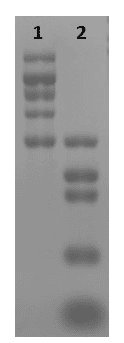
How to Determine Hyaluronic Acid Molecular Weight Using Gel Electrophoresis? Contact Creative PEGWorks.