
 Cart : 0
 Account
A recent review article discussed in details the current status and future prospect of protein…
The Historical Evolution of PEGylation: From Early Concepts to Clinical Validation to Advanced Platform for Biopharmaceuticals
PEGylation, the covalent attachment of polyethylene glycol (PEG) chains to therapeutic molecules, has evolved from a laboratory innovation in the 1970s into a mature, commercially validated technology essential to modern biopharmaceuticals. Its development reflects progressive improvements in polymer chemistry, conjugation techniques, and manufacturing scale-up, culminating in sophisticated platforms such as those advanced by Nektar Therapeutics.
Foundational Discoveries (1970s)
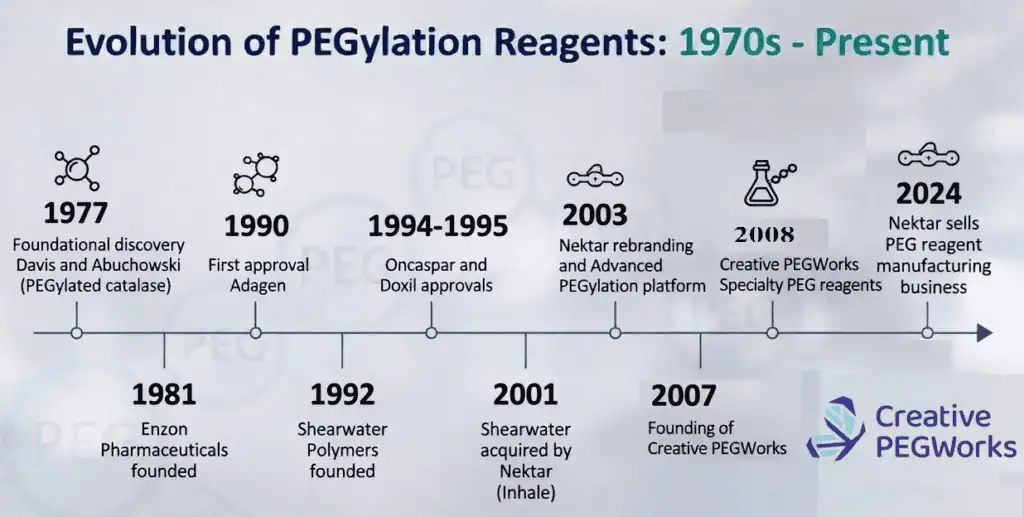
The origins of PEGylation trace to the late 1970s, when researchers Frank F. Davis and Abraham Abuchowski at Rutgers University demonstrated that attaching PEG to proteins could effectively shield them from immune recognition and proteolytic degradation. Their seminal 1977 paper on PEGylated bovine liver catalase established the core principle: PEG’s hydrophilic, flexible, and biocompatible nature extends circulation half-life while reducing immunogenicity without substantially compromising biological activity. [1]
This work laid the scientific foundation for the field. Early PEGylation was primarily random and multi-site, targeting lysine residues via amine-reactive chemistries. Limitations in homogeneity and control prompted subsequent refinements.
Commercialization and First Approvals (1980s–1990s)
In 1981, Davis and Abuchowski founded Enzon Pharmaceuticals to commercialize PEGylation technology. Enzon’s efforts yielded the first FDA-approved PEGylated product: Adagen (pegademase bovine), approved in 1990 for severe combined immunodeficiency (SCID). This milestone validated PEGylation’s clinical utility. [2]
Subsequent approvals included:
- Oncaspar (pegaspargase, 1994) for acute lymphoblastic leukemia.
- Doxil (PEGylated liposomal doxorubicin, 1995), marking the technology’s extension to drug delivery systems. [3]
During this era, PEG reagents remained relatively basic—primarily linear, polydisperse methoxy-PEG (mPEG) with molecular weights of 5–12 kDa and simple reactive end-groups. Supply was limited, often handled in-house or through small specialty manufacturers.
Emergence of Shearwater Polymers (1992–2001)
A pivotal advancement occurred in 1992 with the founding of Shearwater Polymers in Huntsville, Alabama, by Dr. J. Milton Harris, a polymer chemist from the University of Alabama in Huntsville. Shearwater specialized in the design and production of high-quality activated PEG reagents tailored for pharmaceutical applications. [4]
Shearwater introduced more sophisticated reagents, including:
- Branched PEG structures.
- Improved linker chemistries (e.g., NHS esters, maleimides, propionaldehydes).
- Higher-purity products suitable for GMP manufacturing.
The company supplied reagents for numerous preclinical, clinical, and commercial programs, significantly expanding the accessibility and reliability of PEGylation. Its catalogs from the mid-1990s documented a wide array of functionalized PEG derivatives, supporting the transition from research-grade to scalable pharmaceutical use.
Integration and Expansion at Nektar Therapeutics (2001–Mid-2000s)
In 2001, Shearwater was acquired by Inhale Therapeutic Systems (which rebranded as Nektar Therapeutics in 2003). This acquisition integrated Shearwater’s PEG reagent manufacturing expertise and Huntsville facility into Nektar’s broader drug delivery platform. [5]
Under Nektar, the technology evolved into Advanced PEGylation or “Nektar Molecule Engineering.” Key developments included:
- Higher molecular weight and multi-arm PEG architectures for enhanced shielding and pharmacokinetic control.
- Site-selective conjugation strategies to improve product homogeneity.
- Application beyond proteins to small molecules, peptides, and polymer conjugates.
- Expansion of the Huntsville facility into a 124,000 sq. ft. commercial-scale, FDA-inspected manufacturing site. [6]
Nektar’s platform enabled nine approved PEGylated products for partners, including major blockbusters such as PegIntron, Neulasta, and Pegasys. The company also developed its own pipeline candidates using PEGylation, such as NKTR-102 (peg-irinotecan). [7]
Transition and Market Fragmentation (Mid-2000s Onward)
As Nektar shifted its strategic focus toward proprietary therapeutics development, it gradually reduced emphasis on broad catalog sales of PEGylation reagents. The 2024 divestiture of its commercial PEG reagent manufacturing business marked the formal end of Nektar’s direct involvement in supplying catalog and custom PEG reagents to the wider market. This transition created opportunities for specialized suppliers to fill the gap in research-grade and mid-scale PEG products. [8]
In response to growing demand for accessible, high-quality PEG reagents, several companies emerged to serve the research and early-development segments. Creative PEGWorks, among others, founded in 2007 in Winston Salem, North Carolina, later relocated to the Research Triangle Park of North Carolina, quickly became a leading provider of functionalized PEG derivatives, offering a wide catalog of activated PEGs, linkers, and custom synthesis services with an emphasis on high purity and low polydispersity. [9]
Significance of the Evolution PEGylation
By the mid-2000s, PEGylation had matured from rudimentary protein modification to a versatile, industrialized technology. The journey from academic discovery through Enzon’s commercialization, Shearwater’s specialized reagent innovation, and Nektar’s advanced platform and manufacturing scale-up established the foundation for today’s market. This progression addressed key challenges—immunogenicity, half-life extension, and manufacturability—while enabling a growing pipeline of long-acting therapeutics.
The legacy of these developments continues to influence current standards in high-purity, site-specific, and GMP-grade PEG reagents, setting the stage for subsequent independent entities focused on specialized supply.
References
[1] Abuchowski, A., et al. (1977). Effect of covalent attachment of polyethylene glycol on immunogenicity and circulating life of bovine liver catalase. Journal of Biological Chemistry.
[2] Veronese, F. M. (2008). PEGylation: Posttranslational bioengineering of protein biopharmaceuticals. Drug Discovery Today: Technologies.
[3] Gao, Y., et al. (2023). PEGylated therapeutics in the clinic. PMC.
[7] Nektar Therapeutics. (2007, November 14). Nektar’s Leading PEGylation and Pulmonary Technology Platforms.
[9] Creative PEGWorks. (n.d.). Company Overview and History.