 Cart : 0
 Account
Creative PEGWorks is now offering a series of PEG Dendrimers with biodegradable building blocks. Dendrimers…
Unlock PEG-Norbornene: One Revolutionary Thiol-Ene Click Chemistry Tool for Cytocompatible Hydrogels with Advanced Biomaterial Properties
Poly(ethylene glycol)-norbornene, commonly called PEG-norbornene or PEGNB, has become one of the most useful macromers in modern biomaterials chemistry. It enables rapid, orthogonal, and highly cytocompatible hydrogel formation through thiol-norbornene (thiol-ene) click chemistry. Researchers use it extensively for 3D cell culture, bioprinting, controlled release, and tissue engineering scaffolds because it combines the biocompatibility and hydrophilicity of PEG with the precision of step-growth click crosslinking.
What Is PEG-Norbornene?
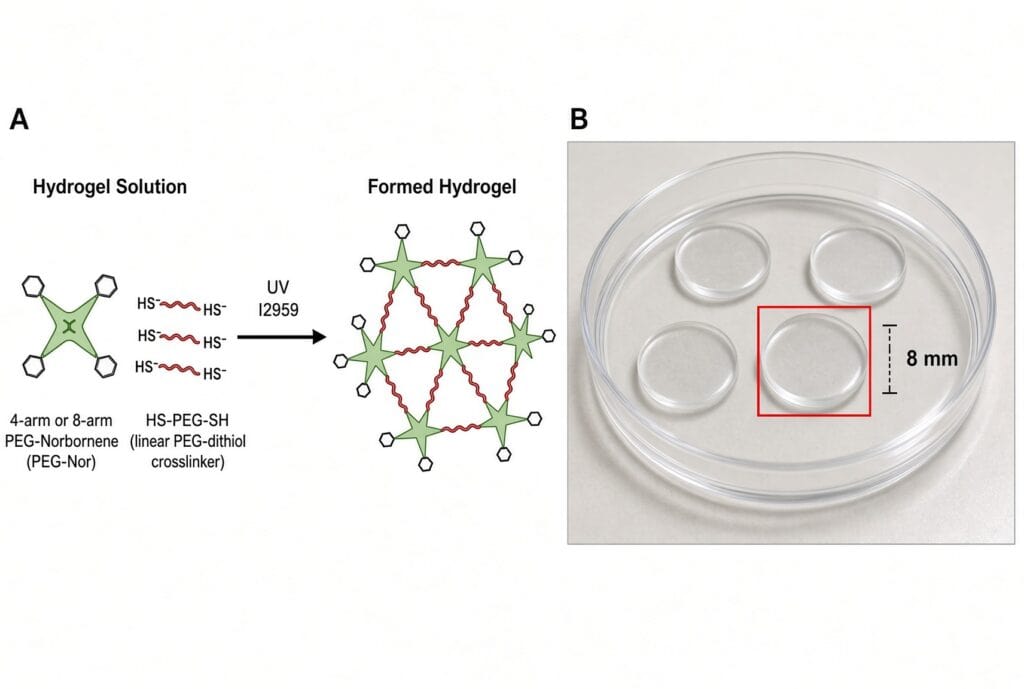
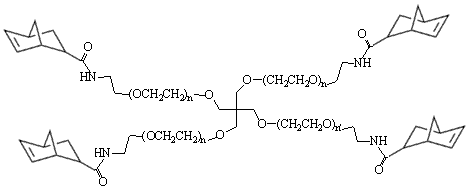
PEG-norbornene consists of a polyethylene glycol backbone functionalized with norbornene groups. These groups can be placed at both ends of a linear PEG (norbornene-PEG-norbornene) or at the termini of multi-arm PEGs (typically 4-arm or 8-arm). The norbornene moiety is a strained bicyclic alkene that reacts efficiently with thiols under radical conditions.
In commercial products, the norbornene is most often attached through stable amide bonds. Hydrolytically labile ester linkages are also available when controlled degradation is desired. The starting norbornene material is usually a mixture of endo and exo isomers (predominantly endo); both isomers show nearly identical reactivity in thiol-ene reactions.
How Thiol-Norbornene Crosslinking Works
The reaction is a classic radical-mediated step-growth process. A photoinitiator (most commonly lithium phenyl-2,4,6-trimethylbenzoylphosphinate, or LAP) is cleaved by long-wave UV or visible light to generate radicals. These radicals abstract hydrogen from thiol groups, producing thiyl radicals that add across the norbornene double bond. The result is a clean thioether linkage.
Key advantages of this chemistry include:
- No oxygen inhibition — unlike many acrylate systems, gelation proceeds efficiently even in ambient conditions.
- Fast kinetics — gel points are often reached in seconds to a few minutes at low photoinitiator concentrations (typically 0.05–0.2 wt% or ~1–2 mM LAP).
- Orthogonal and stoichiometric control — the reaction is highly selective for thiols over other functional groups present in cells or proteins. Mechanical properties and biochemical cues (e.g., cell-adhesive peptides) can be tuned independently.
- High cytocompatibility — lower radical concentrations and the absence of chain-growth side reactions make in situ cell encapsulation more reliable than many competing photopolymerization methods.
Common thiol crosslinkers include linear PEG-dithiol, multi-arm PEG-thiols, and bis-cysteine peptides. When the peptide contains an MMP- or protease-cleavable sequence, the resulting hydrogel becomes cell-degradable.
Biomedical Applications
PEG-norbornene hydrogels have been used across a wide range of applications:
- 3D cell culture and encapsulation — human mesenchymal stem cells, induced pluripotent stem cells, primary chondrocytes, valvular interstitial cells, pancreatic β-cells, and various cancer cell lines have all been successfully encapsulated with high viability.
- Bioprinting and biofabrication — rapid curing and low viscosity of precursor solutions support digital light processing (DLP) and extrusion-based bioprinting of complex geometries.
- Controlled release — protease-sensitive peptide crosslinkers enable on-demand release of proteins or drugs; affinity-based sequestration is also straightforward.
- Tissue engineering — scaffolds for cartilage, bone, cardiovascular, neural, and hepatic applications have been reported. Mechanical stiffness is readily tuned by macromer concentration, arm number, and thiol-to-norbornene ratio (typically near 1:1).
- Dynamic and photodegradable systems — residual norbornene groups allow secondary patterning with thiolated biomolecules. Certain carboxylate-bearing variants can also undergo radical-mediated photodegradation for spatiotemporal control.
Practical Considerations
For reliable results:
- Maintain near-stoichiometric thiol-to-norbornene ratios for ideal network formation.
- Use LAP as the preferred photoinitiator for its high water solubility and efficiency at low concentration.
- Store dry PEG-norbornene at –20 °C or lower. Aqueous stock solutions of non-oxygen-sensitive derivatives can be kept refrigerated for short periods but should avoid repeated freeze-thaw cycles.
- When incorporating bioactive peptides, pre-react them with excess norbornene groups under light before final network crosslinking if spatial patterning is desired.
Looking Ahead for PEG-Norbornene Hydrogel
PEG-norbornene continues to expand the design space for synthetic extracellular matrices. Improvements in aqueous and scalable synthesis, combined with dual click reactivity (thiol-ene + tetrazine-norbornene), make it increasingly accessible for both academic labs and translational work. Whether the goal is a soft, cell-permissive matrix for stem-cell expansion or a stiff, protease-degradable scaffold for tissue regeneration, PEG-norbornene remains one of the most modular and reliable tools available.
High-purity linear and multi-arm PEG-norbornene reagents (amide-linked as standard, ester-linked by custom synthesis) are readily available for research use, enabling laboratories to move quickly from concept to functional hydrogel.